




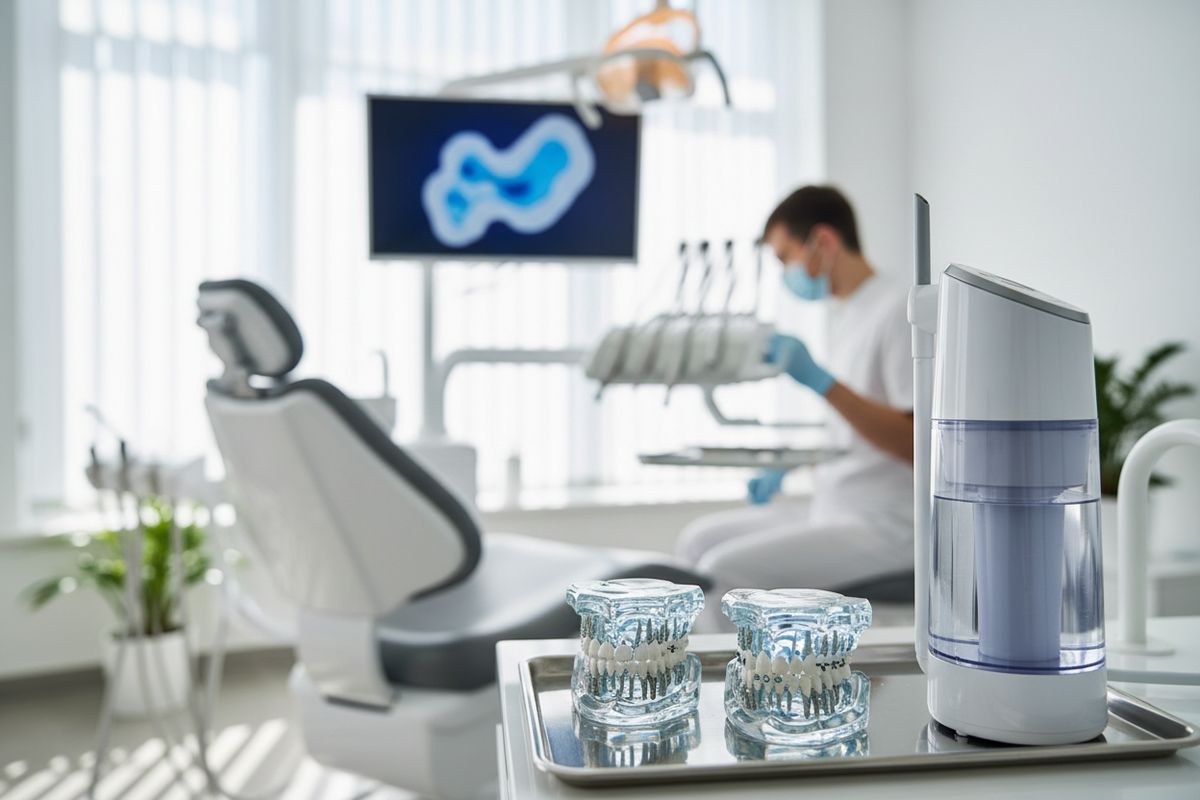
Water flossers are commonly considered for dental implant and orthodontic patients because they may help reduce plaque and bleeding in areas that are difficult to access with traditional flossing methods. Studies suggest that patients with implants and fixed orthodontic appliances face unique challenges in maintaining optimal oral hygiene, as conventional mechanical plaque control can be less effective around these restorations and appliances (S2, S3). Water flossers offer an alternative that targets interdental spaces and subgingival areas, supporting improved hygiene in these complex cases.
Choosing the right water flosser for implant and orthodontic patients requires careful consideration of device features, such as pressure control and tip variety, to address their specific needs. In the UAE, clinicians must also account for local factors including voltage compatibility, water quality, and product availability. Understanding these unique requirements enables dental professionals to make informed recommendations that support long-term oral health for their patients with implants or braces.
Clinical Rationale: Why Water Flossers for Implants and Braces?
Maintaining optimal oral hygiene is particularly challenging for patients with dental implants and fixed orthodontic appliances. Conventional mechanical plaque control methods, such as string floss, often prove difficult or ineffective in these groups due to restricted access and complex prosthetic or wire structures. Studies suggest that water flossers may reduce plaque and gingival bleeding around implants and orthodontic appliances, offering a practical adjunct to traditional cleaning methods. For example, evidence from clinical trials indicates that water flossers may be more effective than string floss for reducing bleeding and improving peri-implant health in some implant patients, while also supporting plaque control and gingival health in orthodontic cases (see review of water flosser brands). These benefits may be relevant in the UAE, where patient compliance and access to advanced oral hygiene devices can be important considerations for clinicians.
Evidence Review: Clinical Efficacy of Water Flossers for Implants
Several clinical trials have compared the effectiveness of water flossers and string floss for maintaining peri-implant health. Evidence from recent randomized trials indicates that water flossers may reduce bleeding around dental implants more effectively than string floss, particularly when used alongside manual toothbrushing (W5). Studies have also reported that water flossers can remove plaque and debris from implant surfaces, supporting improved oral hygiene in these challenging areas (W9). Outcome measures in these trials typically include plaque scores, bleeding on probing, and biomarkers of peri-implant inflammation such as interleukin-6 levels (S4). However, the strength of evidence is influenced by study duration, sample size, and variations in device use protocols. While current data suggest water flossers are a valuable adjunct for implant maintenance, further long-term studies are needed to clarify their impact on peri-implant disease prevention (S4, W5).
Evidence Review: Water Flossers in Orthodontic Care
Recent systematic reviews and clinical trials have evaluated the role of water flossers for patients with fixed orthodontic appliances. Evidence suggests that water flossers may help reduce plaque and gingival bleeding in orthodontic patients, though results are mixed and vary by study design and outcome measures. For example, a 2024 systematic review reported modest improvements in gingival health and plaque indices when oral irrigators were used as an adjunct to regular brushing, but did not consistently demonstrate superiority over traditional interdental cleaning methods (S6, S9). One randomized trial found no significant difference between water flossers and super floss for overall oral hygiene efficacy in orthodontic patients (S7). Patient compliance and satisfaction with water flosser use may be higher, likely due to ease of use around brackets and wires, but this is not universally quantified (S10). Limitations of the current evidence include short study durations, heterogeneity in device types and protocols, and a lack of long-term clinical outcome data.
Key Selection Criteria for Water Flossers in Implant and Orthodontic Patients
Essential Features for Clinical Recommendation
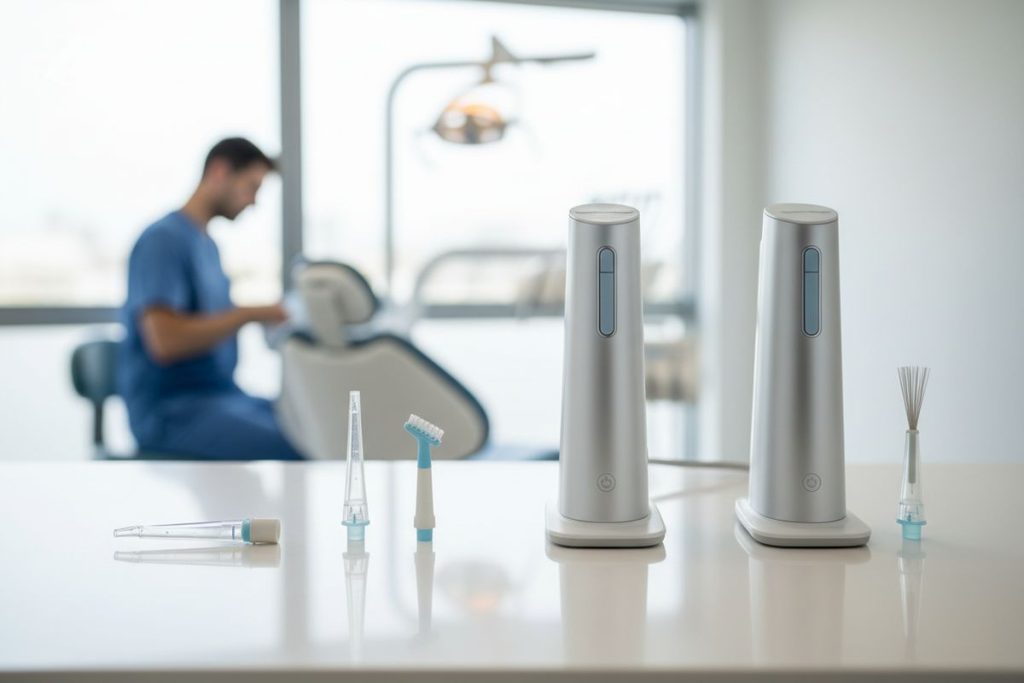
When selecting a water flosser for implant or orthodontic patients, several device features are particularly important. Adjustable pressure settings allow clinicians and patients to tailor the force for sensitive peri-implant tissues or around fixed appliances. Multiple tip options—such as the orthodontic tip for brackets, plaque seeker tip for implants, and classic jet tip—support targeted hygiene in complex restorative and orthodontic scenarios. Ease of cleaning and maintenance is crucial to prevent microbial buildup within the device, especially for frequent use.
| Feature | Implant Care | Orthodontic Care | UAE Consideration |
|---|---|---|---|
| Pressure Settings | Adjustable, gentle mode | Adjustable, higher for debris | Voltage compatibility |
| Tip Variety | Plaque seeker, classic jet | Orthodontic, classic jet | Local tip availability |
| Cleaning/Maintenance | Removable reservoir | Removable reservoir | Water quality adaptation |
For UAE practices, confirming voltage compatibility, access to replacement tips, and adaptation to local water quality are practical steps when recommending a device.
Comparing Leading Water Flosser Options in the UAE
Device and Tip Options for Clinical Needs
Several water flosser models are available in the UAE, each offering distinct features for implant and orthodontic care. The Waterpik Water Flosser WP-660 provides seven interchangeable tips, including options suitable for implants and braces, plus a compact design and pulse-modulation technology. The Waterpik Ultra Water Flosser WP-100 is clinically proven for plaque and gingival bleeding reduction and comes with multiple tip types. The API Aquapick Water Flosser/Oral Irrigator is indicated for both orthodontic and implant patients, with adjustable pressure and a high-capacity reservoir. The Oracura OCE01 Eco Water Flosser features three modes, ultra-fine water flow, and two nozzle tips. The iVismile Water Flosser is intended for interdental cleaning with a focused water stream (product id: 11).
| Model | Key Features | Tip Variety | Implant/Ortho Use |
|---|---|---|---|
| WP-660 | Pulse-modulation, compact, 7 tips | Classic, orthodontic, plaque seeker | Yes/Yes |
| WP-100 | Clinically proven, multiple tips | Classic, orthodontic, plaque seeker | Yes/Yes |
| Aquapick | Adjustable pressure, 600ml tank | Standard, orthodontic | Yes/Yes |
| Oracura OCE01 | 3 modes, ultra-fine flow | 2 nozzle tips | Potential/Yes |
| iVismile | Interdental water cleaning | Not specified | Potential/Potential |
Clinicians in the UAE can review detailed options and availability at the dedicated water flosser resource page for regional guidance.
Review: iVismile Water Flosser in Implant and Orthodontic Care
The iVismile Water Flosser is designed for interdental cleaning using a focused water stream, which may be useful for patients with dental implants or fixed orthodontic appliances. Its application targets areas that are difficult to access with traditional floss or brushes, such as around implant-supported restorations and under orthodontic wires.
For implant patients, the device’s water flow may help dislodge debris and disrupt plaque in peri-implant areas, supporting oral hygiene where mechanical tools can be limited. Orthodontic patients may benefit from its ability to reach beneath archwires and around brackets, addressing hygiene challenges unique to fixed appliances. Practical considerations for UAE clinics include ensuring compatibility with local water quality and electrical standards, as well as confirming the availability of appropriate tips for specific patient needs. Manufacturer guidance should be followed regarding device maintenance and usage protocols.
Safe and Effective Patient Use: Clinical Guidance
Initiating water flosser use after implant placement should be based on clinical healing, with most sources advising that patients wait until the surgical area has sufficiently healed and their treating dentist confirms it is safe to begin. This period may range from two weeks to longer, depending on individual healing and closure of the gingival tissues (W8) (W10). When using a water flosser around implants, patients are generally advised to hold the tip at a 90-degree angle to the gumline and spend approximately three seconds per implant site, following manufacturer and clinician instructions (W2). Lower to moderate pressure settings are generally recommended, especially initially, to avoid tissue trauma. Professional instruction on device use, tip selection, and ongoing follow-up are essential for optimal outcomes. For detailed guidance, clinicians can refer to water flosser patient instructions tailored for the UAE context.
Conclusion
Choosing an appropriate water flosser for patients with dental implants or fixed orthodontic appliances requires an evidence-based and patient-centered approach. Studies suggest that water flossers may help reduce plaque and bleeding around implants and braces, offering a practical adjunct to mechanical cleaning for these groups (S1, S2, S3, S5, S6, S9). However, device effectiveness depends on selecting models with suitable pressure settings, tip options, and ease of use tailored to individual patient needs.
For optimal outcomes, UAE dentists should:
- Assess device features such as adjustable pressure, tip variety, and cleaning ease for each patient group.
- Match tip types (e.g., orthodontic, plaque seeker, classic jet) to the clinical scenario.
- Consider local factors: voltage compatibility, water quality, and product availability.
- Provide detailed patient instruction and periodic follow-up to ensure safe and effective use (W2).
Ultimately, integrating professional guidance with appropriate device selection supports better oral hygiene and maintenance for implant and orthodontic patients.
Frequently Asked Questions
What is an appropriate water flosser tip for dental implants?
Tips designed for implants, such as plaque seeker or classic jet tips, may be suitable; always follow manufacturer and clinical guidance.
Is a water flosser safe to use around dental implants?
Studies suggest water flossers can be used safely around implants once healing is confirmed by the dentist.
Can water flossers replace string floss for orthodontic patients?
Water flossers may help maintain oral hygiene in orthodontic patients, but mechanical cleaning remains important.
How soon after implant placement can a patient use a water flosser?
Initiation depends on healing; patients should follow their dentist’s specific advice.
References
- The effectiveness of oral irrigators on periodontal health status and oral hygiene of orthodontic patients: a systematic review and meta-analysis (2024)
- Revolutionizing Dental Care-Evolution, Current Applications, And Future Prospects of Oral Irrigators: A Narrative Review (2025)
- Comparison of the effect of two interdental cleaning devices around implants on the reduction of bleeding: a 30-day randomized clinical trial. (2013)
Last updated: 2026-11-08
Related products at Nutrident


Dentist, Iran Medical Council registration No. 233463 · Last reviewed: 8 November 2026
Nutrident educational content is based on credible sources and reviewed under his supervision. This article is for professional education and does not replace clinical examination or the judgement of the treating dentist.